The title industry is heading into 2026 with more moving parts than at any time in recent memory: rapid regulatory change, deeper fraud risk, new expectations from lenders and consumers, and a wave of technology that is finally starting to impact day-to-day workflows at scale.
In our 2025 outlook, we focused on emerging themes like advanced data analytics, cybersecurity, and customer-centric innovation. Those themes are not going away; they are maturing and converging into concrete expectations placed on title professionals in every market.
This outlook takes a practical view of ten trends that will redefine what “good due diligence” and “a smooth closing” really mean in 2026, and what title companies, attorneys, and lenders can do now to stay ahead.
1. AI-Assisted Search and Production Moves From Pilot to Standard Practice
Artificial intelligence in title and escrow has moved beyond early experimentation. Industry-specific platforms are now using AI to classify documents, extract key fields, detect inconsistencies, and assist with clearing common requirements. Recent research on AI adoption in title and escrow shows that a growing share of companies are already using AI in production, not just testing it in a sandbox.
What this means for due diligence in 2026:
Turn times will continue to compress, particularly for straightforward residential files.
Clients will expect fewer “human error” issues in basic data entry, indexing, and document labeling.
Underwriters and regulators will pay closer attention to how decisions are made and documented.
Practical steps:
Map where your team spends the most manual time in search, exam, and commitment prep. Start AI pilots there, especially in document classification, extraction of key data points, and preliminary risk flagging.
Require any AI vendor to show a clear audit trail. You need to know what the system relied on, when, and how a human can override or correct it.
Treat AI as an “assistant” to experienced examiners, not a replacement. Use it to handle volume and pattern recognition, while humans retain the authority on nuanced risk calls and local quirks.
The organizations that win in 2026 will be those that combine AI tools with strong training, clear policies, and a culture where staff understand both the power and limits of these systems.
2. Digital Closings and RON Become Expected, Not Exceptional
Remote Online Notarization (RON) and hybrid digital closings are now firmly in the mainstream. By early 2025, RON is authorized in 45 states and the District of Columbia under permanent statutes, with others offering partial or evolving frameworks.
For title companies, this is no longer about whether digital closings will stick. The question is how you will operationalize them across multiple states, lenders, and underwriters while preserving quality and compliance.
Implications for 2026:
More lenders will default to digital or hybrid closing models for certain loan products.
Borrowers will increasingly view in-person, paper-heavy closings as outdated unless there is a specific reason.
The gap between “digital-ready” title operations and those still glued to paper will widen.
How to prepare:
Build standardized workflows for fully remote, hybrid, and traditional closings so staff know exactly which checklist to follow.
Confirm RON and eNotary requirements by state and underwriter. Maintain a living reference that is easy for closers to access.
Partner with technology providers that support both eSign and eRecording, and that can integrate with your production system for better tracking.
Communicate clearly with referral partners about what you can offer in each county or state so expectations are aligned upfront.
Digital closings are no longer a nice differentiator. In 2026 they are part of the baseline value proposition.
3. FinCEN, CTA, and Beneficial Ownership Reporting Reshape Data Requirements
Anti-money laundering expectations for real estate continue to ratchet up. FinCEN has renewed and expanded Geographic Targeting Orders (GTOs) that require title insurance companies to identify beneficial owners behind legal entities in certain all-cash residential purchases, signaling an ongoing focus on real estate as a potential money-laundering channel.
At the same time, the Corporate Transparency Act’s beneficial ownership reporting regime has introduced new obligations for many corporations and LLCs formed in the United States, with real estate structures squarely in scope.
Even though the regulatory picture continues to evolve, the direction of travel is clear: more transparency, more reporting, and more shared responsibility among participants in a transaction.
What this means for title operations:
Staff must be comfortable collecting, verifying, and securely storing information about individuals who own or control entity buyers and sellers.
Underwriters and lenders will increasingly ask how your processes align with emerging AML expectations.
In some markets, additional questionnaires or certifications will become standard parts of the closing package.
Action items:
Develop standardized intake procedures when an entity is involved. This includes gathering organizational documents, beneficial ownership details, and sources of funds, consistent with applicable rules and underwriter guidance.
Train staff to recognize red flags that may warrant escalation, such as unusual ownership structures, repeated entity flips without clear business purpose, or inconsistent signatory authority.
Coordinate with underwriters to ensure your policies, checklists, and documentation expectations reflect their latest risk appetite and regulatory interpretations.
Title professionals do not need to become AML compliance officers, but they do need to understand where their responsibilities begin and end, and how to document compliance consistently.
4. Fraud Risk Intensifies Across Wire, Identity, and Synthetic Schemes
Fraud in real estate transactions is no longer an occasional horror story. It is a steady, well-organized threat. FBI data show that reported losses from wire fraud in real estate rose from under 9 million dollars in 2015 to hundreds of millions in 2022, and industry reports indicate that one in ten Americans has been targeted by real estate fraud, with a material share actually suffering financial loss.
Business email compromise used to alter wiring instructions.
Fake or manipulated pay-off statements.
Synthetic identities or forged IDs for buyers, sellers, or signers.
Phishing and credential-theft attacks aimed at staff.
For 2026, “clear to close” must explicitly include “clear to fund securely.”
Practical moves:
Require out-of-band verification for any new or changed wiring instructions. That means phone calls to known numbers, not those supplied in a suspect email.
Use ID verification tools, especially for remote closings and higher-risk transactions.
Train your staff and your referral partners. Many fraud attempts can be thwarted by a well-trained processor or closer who recognizes unusual behavior or timing.
Implement basic but often neglected security controls: multi-factor authentication, strong password policies, regular updates, and limits on who can initiate or approve wires.
Fraud prevention is now a core part of due diligence, not a separate IT concern. The firms that take it seriously will protect both their clients and their own brand.
5. Off-Record Risk Becomes Central to the Value Proposition
The industry has long understood that “title” is more than the deed and the mortgage. Municipal liens, unpaid utility balances, code violations, special assessments, and HOA obligations can all create significant post-closing risk, yet many are not visible in the traditional land records.
Investors and lenders are more aware of this exposure, particularly in jurisdictions where municipal and quasi-governmental entities maintain their own separate records. Buyers who are hit with surprise assessments or enforcement actions after closing are far less likely to give anyone the benefit of the doubt.
What changes in 2026:
Municipal lien searches, HOA research, and tax certification work will increasingly be baked into standard due diligence instead of treated as optional add-ons.
Larger lenders and institutional buyers will push for consistent off-record risk coverage across states to simplify their own underwriting and asset-management processes.
Title companies will look for partners that can handle complex local research with predictable turn times and clear reporting.
How to respond:
Define when a municipal lien search is strongly recommended or required, based on property type, jurisdiction, and client profile. Put this in writing so staff can explain it consistently.
Partner with specialized providers, such as Skyline Title Support, that focus on municipal lien searches and related due-diligence products. This allows your in-house staff to focus on core title work while still delivering comprehensive coverage.
Present off-record findings in a way that is easy for clients to understand: what the issue is, why it matters, and what options they have before or after closing.
In 2026, a strong municipal and off-record program will be one of the clearest ways to differentiate your service and protect your clients.
6. System Integration and Data Flow Become Non-Negotiable
The era of re-keying the same information into three or four separate systems is ending. Production platforms, closing software, lender portals, CRM systems, and third-party search providers are under growing pressure to integrate.
When systems do not talk to each other, you see:
Longer cycle times caused by manual data entry.
More opportunities for error (for example, a misspelled name or wrong loan amount in one system).
Poor visibility into where an order stands at any given moment.
By 2026, more title companies will demand that their core vendors support API connections, event-based updates, and structured data exports.
Action steps:
Document where data originates, where it needs to go, and where it currently gets duplicated. This gives you a roadmap for integration.
When evaluating vendors, ask specific questions about available APIs, pre-built integrations, and the cost and timeline for connecting systems.
Use dashboards to monitor key metrics: order volume, turn times by product and jurisdiction, revision rates, and error categories.
For a company like Skyline Title Support, this also means providing clean, well-structured search results that drop into the client’s system without forcing manual re-work. That level of integration support will be a competitive advantage.
7. Cybersecurity and Vendor Oversight Move Into the Core Risk Framework
As title and settlement operations adopt more technology and handle more sensitive data, cybersecurity risk rises sharply. Across industries, AI-enabled cyberattacks are becoming more frequent and more sophisticated, and defenders are increasingly using AI tools of their own to detect and respond to threats more quickly.
Regulators, underwriters, and large lender clients expect title companies to have:
Written information security programs that match the scale of their operations.
Regular staff training on phishing, social engineering, and data handling.
Vendor oversight processes that assess how partners protect shared data.
Key actions for 2026:
Formalize your security program, even if you are not a large operation. Document who is responsible, how incidents are handled, and how often policies are reviewed.
Establish a vendor-risk review process. For each partner that touches your data or your clients’ data, know where it is stored, how it is encrypted, and what happens if something goes wrong.
Limit internal access to “need to know.” Many breaches are made worse because too many people have access to too much data.
Cybersecurity is no longer purely an IT concern. It is a core operational and reputational risk that must be managed with the same rigor as escrow controls.
8. Margin Pressure Drives Strategic Outsourcing and Process Redesign
Title volumes are cyclical. Interest rate shifts and local market conditions can cause order counts to swing in ways that are difficult to predict. That volatility puts pressure on margins, especially for companies with fixed in-house staffing for every step of the process.
In 2026, more title operations will look at their workflows and ask: which tasks are truly strategic to keep in-house, and which can be outsourced to reliable partners without compromising quality or control?
Good outsourcing candidates:
Highly repetitive, research-intensive tasks like municipal lien searches, HOA estoppel collection, and tax certifications.
Work in specialized or distant jurisdictions where building in-house expertise would be slow and expensive.
After-hours or overflow capacity when volumes spike.
Best practices:
Develop clear service-level agreements (SLAs) around turn times, error rates, and escalation procedures.
Maintain a small, experienced internal team who can review complex findings, handle client escalation, and monitor vendor performance.
Build redundancy into your vendor base so that a single outage or local disruption does not derail your pipeline.
Outsourcing is not just about cost. It is about making sure your highest-skill staff are spending their time on higher-value activities, while repeatable research is handled at scale.
9. Client Experience Becomes a True Competitive Differentiator
Agents, attorneys, and lenders are under their own pressures, and they remember which title partners make their lives easier and which ones do not. In an era when many core services feel similar, client experience will be one of the most important differentiators in 2026.
What “good experience” looks like now:
Predictable timelines, with realistic expectations set early and updated when something changes.
Proactive communication when an issue arises, along with suggested solutions rather than just a problem statement.
Clear, plain-language explanations of complex issues (for example, municipal enforcement actions, prior liens, or conflicting HOA documents).
How to stand out:
Implement simple status updates that can be delivered by email or portal. Even a basic “order received / in progress / awaiting information / complete” model reduces anxiety for clients.
Define response time standards for calls and emails from referral partners. Consistency matters more than perfection.
Turn your off-record and municipal findings into straightforward summaries that non-lawyers can understand. This is where a specialist provider’s reporting format can make you look very good.
In a tight market, the companies that deliver both high-quality work and low-friction communication will win more repeat business from the same referral base.
10. Workforce Shifts Force a New Approach to Training and Knowledge Capture
Many title companies rely heavily on a relatively small group of highly experienced examiners and closers. As these professionals retire or shift roles, there is a risk of losing decades of tacit knowledge about local practices, unusual chains of title, and practical workarounds.
At the same time, newer staff often come in with stronger comfort around technology, but less exposure to complex title issues. That gap must be closed deliberately.
For 2026, winning organizations will:
Capture institutional knowledge in written playbooks, checklists, and exception-handling guides rather than leaving it in someone’s head.
Use real-world examples from their own files to train new staff, not just generic textbook scenarios.
Pair junior staff with senior examiners, supported by AI tools that handle basic pattern-matching, so human expertise is applied where it adds the most value.
This is also where strong vendor relationships help. By leaning on external specialists for complex municipal research or local procedural nuances, your internal team can focus on understanding and explaining the results instead of reinventing the wheel for every jurisdiction.
The 2026 ALTA/NSPS survey standards took effect Feb 23, 2026. See what changed and how title teams should order land surveys to keep closings on track.
A UCC search finds financing statements and fixture liens that a standard title search misses. Learn what it covers, the 5-year rule, and when to order one.
Seller impersonation fraud attempts more than doubled since 2024. Learn the red flags title teams miss and how to verify a seller before you insure the deal.
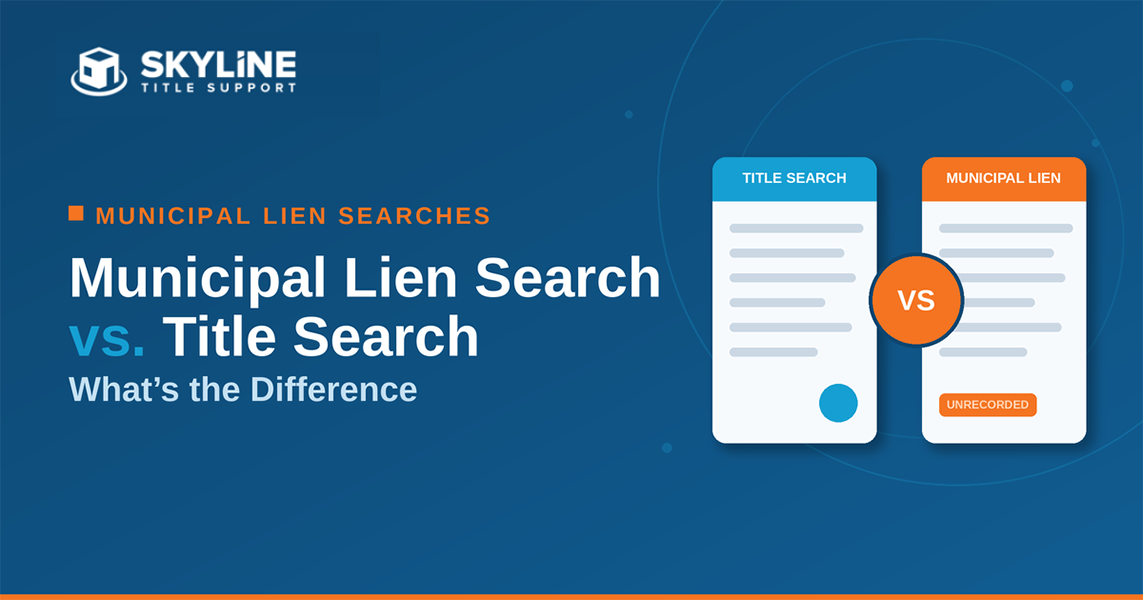
A title search reads the public land records; a municipal lien search reads the city's billing records. See what each catches—and why closings need both.