Mobile Notary Services are Now Available - Nationwide Coverage Learn More →


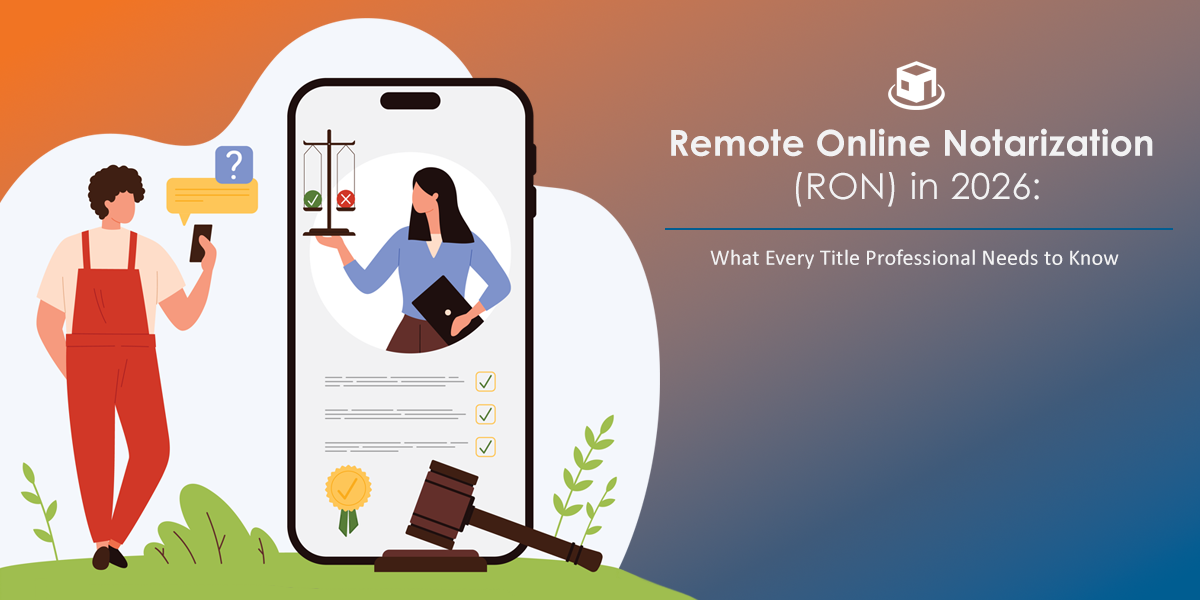
Five years ago, remote online notarization felt experimental. Title companies tested it cautiously during the pandemic, treating it like a temporary workaround rather than a permanent shift in how closings get done. Fast-forward to 2026, and the landscape looks completely different. More than 45 states have enacted permanent RON legislation, lenders are increasingly requiring digital closing capabilities from their settlement partners, and federal legislation is working its way through Congress to standardize the process nationwide.
For title professionals who haven't yet integrated RON into their operations, the window to get ahead of the curve is closing. For those who have, there's still work to do in refining workflows, staying compliant across jurisdictions, and meeting evolving lender expectations. Either way, understanding where RON stands today and where it's heading is essential for any title company that wants to stay competitive.
Remote online notarization allows a notary public and a signer to complete the notarization process from different physical locations using audio-visual technology. Unlike traditional in-person notarizations or even ink-signed e-closings, RON sessions happen entirely through a secure digital platform. The signer verifies their identity through knowledge-based authentication (KBA) questions and credential analysis of a government-issued ID, then signs documents electronically while the notary witnesses and applies a tamper-evident electronic seal.
The entire session is recorded and stored securely, creating an audit trail that, in many ways, is more robust than what you get from a traditional wet-ink signing at a conference table.
As of early 2026, approximately 45 states and the District of Columbia have permanent RON laws on the books. That covers roughly 90% of the U.S. population. The remaining holdout states still accept remotely notarized documents for recording thanks to federal requirements, but they haven't yet enacted their own RON authorization statutes.
Florida was one of the earlier adopters, passing HB 409 ("Electronic Legal Documents") in June 2019, with the law taking effect January 1, 2020. Florida-commissioned notaries can perform RON after completing an application through the Florida Department of State and meeting training requirements. The state requires notaries to use an approved RON platform, maintain session recordings, and follow specific identity verification protocols.
For Florida-based title companies, this means the legal infrastructure has been in place for over six years. The question isn't whether you can offer RON closings; it's whether you're doing it efficiently and compliantly.
Here's where it gets complicated for title companies operating across state lines. While most states authorize RON, the rules are far from uniform. Some states require the notary to be commissioned in the state where the property is located. Others allow any RON-commissioned notary to notarize documents regardless of the property's location. Recording requirements, session storage periods, acceptable technology platforms, and identity verification standards all vary.
This patchwork creates real operational headaches for title companies handling multi-state transactions. A process that works perfectly for a Florida closing might not meet the requirements in Texas or New York, and getting it wrong can delay closings or create title defects.
The good news is that Congress is actively working on a solution. The SECURE Notarization Act of 2025 (H.R. 1777 in the House, S. 1561 in the Senate) was introduced in March 2025 with bipartisan support. The bill would establish national minimum standards for electronic and remote notarizations, require interstate recognition of RON-commissioned notaries, and effectively open up RON in the remaining states that haven't passed their own laws.
Key provisions include requirements for simultaneous audio-visual communication between the notary and signer, mandatory recording and retention of RON sessions, and specific identity verification protocols. The bill is currently in committee, and while passage isn't guaranteed, the bipartisan backing and broad industry support from organizations like the American Land Title Association (ALTA) and the Mortgage Bankers Association (MBA) suggest meaningful momentum.
If the SECURE Act passes, it would eliminate the biggest friction point in RON adoption: the inconsistency between state laws that makes multi-state closings unnecessarily complex.
Title companies don't operate in a vacuum. Lender expectations are a major driver of operational decisions, and the lending industry is increasingly moving toward digital closings. Here's why that matters for your title operation.
Most digital closings can be completed in about half the time of a traditional in-person signing. When a lender is managing tight rate-lock deadlines or trying to close a pipeline of loans before month-end, that time savings translates directly into reduced costs and better borrower satisfaction. Title companies that can facilitate fast, smooth RON closings become preferred settlement partners.
Today's borrowers, especially younger homebuyers, expect digital-first experiences. They've applied for their mortgage online, uploaded documents through a portal, and communicated with their loan officer via text. Asking them to drive to a title office, sit in a conference room, and sign 100+ pages of paper feels like a step backward. RON lets the closing experience match the rest of the transaction.
Before you can offer RON closings, your title underwriter needs to be on board. The major underwriters now accept RON transactions, but some enforce specific requirements around which platforms are acceptable, how identity verification must be performed, and what documentation needs to be retained. If you haven't had a conversation with your underwriter about their RON policies recently, that should be on your to-do list this quarter.
If you're ready to add RON to your closing toolkit, or if you're looking to improve an existing RON workflow, here's a practical roadmap.
Not all RON platforms are created equal. Look for a platform that integrates with your existing title production software. If you're using Qualia, ResWare, SoftPro, or another closing platform, check whether the RON provider offers a direct integration. Seamless data flow between your title production system and your RON platform eliminates duplicate data entry and reduces errors.
Key features to evaluate include multi-state compliance support, identity verification capabilities (KBA and credential analysis), secure session recording and storage, e-notary seal management, and lender/underwriter approval status.
Your in-house notaries will need RON-specific commissions in the states where you operate. In Florida, this means applying through the Department of State's Division of Corporations and completing required training. Budget time for the application process and make sure your notaries are comfortable with the technology before their first live session.
RON changes more than just the signing ceremony. You'll need to update your pre-closing workflow to prepare documents for electronic signing, establish procedures for scheduling and managing RON sessions, create protocols for handling technical issues mid-session (lost connections, failed identity verification, etc.), and ensure your document management system can store RON session recordings alongside the closing file.
Not every lender is ready for RON closings, and those that are may have specific requirements. Reach out proactively to your top lender clients to discuss their RON acceptance policies, preferred platforms, and any special documentation requirements. Being the title company that reaches out first to offer RON capabilities positions you as a forward-thinking partner.
If a full RON closing feels like too big a leap, consider starting with hybrid e-closings. In a hybrid model, some documents are signed electronically before the closing appointment, and only the notarized documents are signed in person (or via RON). This approach reduces signing time, gives your team experience with digital document workflows, and lets you gradually build toward full RON closings.
Some title professionals worry that RON is less secure than in-person notarization. The reality is often the opposite. RON platforms use multi-factor identity verification that goes beyond what a notary can accomplish by glancing at a driver's license. The audio-visual recording creates a permanent record of the signing session, and tamper-evident electronic seals provide verification that documents haven't been altered after signing. In an industry already battling fraud and impersonation schemes, the additional verification layers built into RON are a significant advantage.
Yes, RON platforms come with subscription fees and per-transaction costs. But factor in the savings: reduced printing and shipping costs, fewer scheduling delays, less staff time spent coordinating in-person appointments, and the ability to close transactions across a wider geographic area without sending a notary on the road. For most title companies, the math works out favorably, especially as transaction volume grows.
Some signers, particularly older borrowers or those in rural areas, may prefer in-person closings. That's fine. RON should be an option in your toolkit, not a mandate. The goal is to offer flexibility. When a borrower is traveling, has mobility issues, or simply prefers the convenience of signing from home, you can accommodate them without rescheduling or arranging a mobile notary.
Remote online notarization isn't just a standalone technology. It's one piece of a broader digital transformation happening across the title and settlement industry. When you combine RON with electronic recording (e-recording), digital title searches, automated municipal lien searches, and AI-powered document analysis tools like Skyline's SmartTitle Assistant, you're building a closing operation that's faster, more accurate, and more scalable than anything possible with paper-based processes alone.
Title companies that invest in these technologies now are positioning themselves to handle higher volumes without proportionally increasing headcount, serve clients across a wider geographic footprint, meet increasingly stringent lender and regulatory requirements, and attract younger talent who expect modern technology in their workplace.
Looking ahead through the rest of 2026 and beyond, several developments are worth watching. The SECURE Notarization Act's progress through Congress will determine whether we get a unified federal framework or continue navigating the state-by-state patchwork. Advances in identity verification technology, including biometric authentication and AI-driven fraud detection, will make RON sessions even more secure. Increased lender adoption will create more demand for title companies with RON capabilities, and continued refinement of RON platforms will improve the user experience for both notaries and signers.
The direction is clear. Digital closings are becoming the standard, not the exception. Title companies that embrace RON now will be the ones closing more deals, serving more clients, and operating more efficiently in the years ahead.
Whether you're exploring RON for the first time or looking to streamline an existing digital closing workflow, having the right support services in place makes all the difference. From title searches and municipal lien searches to deed preparations and mortgage payoff letters, Skyline Title Support helps title companies handle the heavy lifting so your team can focus on delivering a modern, seamless closing experience.
Book a demo today to see how Skyline can help your title operation run faster and smarter.