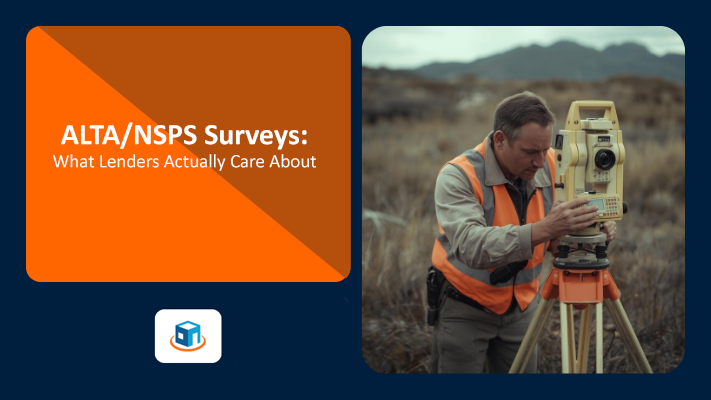
A practical reference for title agents, real estate attorneys, and lenders on what an ALTA/NSPS survey actually costs, how long it realistically takes, and which Table A items your lender will almost certainly require.
Quick Takeaways
- ALTA surveys cost $2,500 to $10,000+ for most commercial properties. Table A items are the biggest cost variable.
- Standard turnaround is 3 to 5 weeks. Rush services exist but can add 40 to 50% to the total cost.
- Confirm lender Table A requirements before the surveyor starts. Adding items mid-project will cost more.
- Items 6a and 6b (zoning) require a separate zoning letter. The surveyor does not provide this document.
- Item 18 (wetlands delineation) was removed from the 2021 standards and must be negotiated separately if needed.
What Is an ALTA/NSPS Survey?
An ALTA/NSPS Land Title Survey is the gold standard for commercial property surveying in the United States. It combines elements of a boundary survey, a title survey, and a location survey into one comprehensive document, produced to a uniform national standard jointly published by the American Land Title Association (ALTA) and the National Society of Professional Surveyors (NSPS).
The current governing standards went into effect on February 23, 2021. Every licensed surveyor in the country producing an ALTA survey is working from the same rulebook. That consistency is the entire point. Lenders, title insurers, and buyers can rely on these surveys because they know exactly what is included and what level of accuracy is required, regardless of which surveyor or which state is involved.
At minimum, an ALTA survey must show:
- Exact property boundary lines and corners
- Location of all improvements, including buildings, parking areas, and fences
- Observed evidence of utilities and utility poles within 10 feet of the property
- All recorded easements referenced in the title commitment
- Encroachments, access rights, and any discrepancies between the legal description and actual field conditions
Always provide the surveyor with the title commitment before work begins. Under the 2021 standards, if a surveyor discovers a recorded easement that was not listed in the commitment, they are required to either show it on the survey or note it. Getting this right early protects all parties from last-minute surprises at the closing table.
How Much Does an ALTA Survey Cost?
There is no flat fee for an ALTA survey. Any firm quoting a number without first reviewing the property details is not giving you reliable information. That said, here are realistic ranges for budgeting purposes:
| Property Type | Typical Cost Range | Notes |
|---|---|---|
| Small commercial lot (urban) | $2,500 to $5,000 | Standard Table A, straightforward title history |
| Mid-size commercial property | $5,000 to $10,000 | Multiple Table A items, moderate complexity |
| Large or multi-parcel property | $10,000 to $25,000+ | Significant acreage, complex easements, or extensive title research |
| Rush or expedited service | Add 25 to 50% to base cost | 3 to 5 business days; availability varies by firm and market |
The factors that drive costs up most significantly:
- Acreage and property shape. More linear footage means more time in the field.
- Number of Table A items requested. Each item adds scope, time, and cost to the project.
- Existing survey records. If prior surveys are provided at the time of order, research time drops significantly.
- Terrain complexity. Wooded, hilly, or waterfront properties take longer to survey than open, flat lots.
- Geographic market. Urban markets like Chicago or New York typically run 10 to 20% above the national average.
- Turnaround time. Rush fees are real and can effectively double the base cost of a standard engagement.
Adding Table A items after the survey is already underway will cost considerably more than including them upfront. The most effective way to control costs is to confirm lender requirements in writing before the surveyor begins any fieldwork.
Turn Times: What Is Realistic?
Every title agent has heard the request to get a survey ordered immediately. Before you make that call, it helps to understand what the timeline actually looks like once an order is placed:
| Service Level | Timeframe | What to Expect |
|---|---|---|
| Standard | 3 to 5 weeks | Full fieldwork, records research, drafting, and review cycle |
| Expedited | 7 to 10 business days | 20 to 30% cost premium; surveyor prioritizes your file in queue |
| Rush | 3 to 5 business days | 40 to 50% premium; not always available; complexity increases quality risk |
The most important takeaway here is to plan ahead. If your commitment deadline is two weeks out and the survey has not been ordered yet, paying for rush service will not always solve the problem. Build 4 to 6 weeks into your closing timeline from order placement to certified delivery.
Missing documents such as the deed, prior survey, or title commitment are the most frequent cause of delays. Other common issues include zoning letters not being secured when Items 6a or 6b are required, access issues requiring property owner permission, and heavily backlogged surveyors in active markets. Most of these are preventable with early coordination.
Table A: The Options That Define Your Survey
Table A is where ALTA surveys get customized, and it is also where miscommunication most often creates problems. Think of it as a menu of optional items that a client, typically the lender or buyer, can request the surveyor to include. Each checked box adds scope, time, and cost to the engagement.
The 2021 standards introduced an important change: Table A items are now negotiable in both wording and fee between the client and the surveyor. That flexibility can be useful, but it also creates room for misalignment. Always confirm the agreed scope in writing before fieldwork begins.
The Table A Items Lenders Most Commonly Require
| Table A Item | What It Covers | Why Lenders Want It |
|---|---|---|
| Item 1 — Monuments | Location of survey monuments set or found during fieldwork | Confirms boundary accuracy and the permanence of the survey |
| Item 2 — Political Jurisdiction | Names of the governing jurisdictions for the property | Confirms property location for title and regulatory purposes |
| Item 3 — Flood Zone | FEMA flood zone classification for the parcel | Required for flood insurance determination and loan underwriting |
| Item 4 — Gross Land Area | Total square footage or acreage of the property | Supports loan sizing, zoning compliance review, and value confirmation |
| Item 6a — Zoning Classification | Current zoning designation from the governing jurisdiction | Confirms the permitted use aligns with the lender's intended use of the property |
| Item 6b — Zoning Setbacks, Height and Parking | Specific dimensional and use requirements under current zoning | Verifies the property and its improvements comply with applicable regulations |
| Item 7a — Exterior Dimensions | Measured building footprint dimensions | Supports the appraisal and the scope of title insurance coverage |
| Item 11 — Underground Utilities | Evidence of underground utility locations on the property | Used for risk assessment in development, financing, and future use decisions |
| Item 19 — Parking Count | Total number of spaces, including ADA-compliant spaces | Required on retail, office, and mixed-use transactions where parking ratios matter |
| Item 20 — Building Square Footage | Gross floor area broken down by floor | Supports the appraisal, rent roll review, and overall value conclusions |
A Few Items Worth Flagging
- Items 6a and 6b require a zoning letter from the governing municipality. The surveyor does not determine zoning. The borrower or their attorney must obtain this letter and provide it to the surveyor before fieldwork is complete, not after.
- Item 11 was significantly revised under the 2021 standards. The 811 "call before you dig" approach was removed for being unreliable. Clients must now either provide existing utility plans or authorize the surveyor to coordinate directly with utility companies. Both paths add time and cost to the project.
- Item 18 (wetlands delineation) was removed from the 2021 Table A entirely. If a lender or title insurer requires wetlands information, it must be negotiated as a separate item outside the standard Table A framework.
What Lenders Actually Care About
Behind every checklist requirement, lenders are really asking one question: is this property what we think it is, and does anything here put our security interest at risk?
The ALTA survey is how they get that answer. Specifically, lenders use it to:
- Confirm the legal description matches actual on-the-ground conditions
- Identify any encroachments onto or from neighboring properties
- Verify that the property has legal ingress and egress
- Locate all recorded easements and understand how they affect the property's use
- Determine flood zone exposure for insurance and underwriting purposes
- Confirm that improvements do not violate setback requirements or encumber recorded easements
Title insurers rely on the same survey when making extended coverage decisions. If an encroachment or access issue shows up, the title company will either require it to be resolved before closing, add a policy exception, or in some situations decline to insure the transaction. The survey is not just a closing deliverable. It is a risk management tool for every party at the table.
As soon as the lender sends over their survey requirements, pull the Table A checklist and share it with the surveyor. Do not wait. Confirming required Table A items at the start of the process is the single most effective way to prevent cost overruns, delays, and last-minute scrambles before closing.
Ordering an ALTA Survey: A Practical Checklist
- Confirm the lender's Table A requirements before placing the order, not after
- Provide the surveyor with the title commitment, any prior surveys, and the deed at the time of order
- If Items 6a or 6b are required, work on securing the zoning letter at the same time, not as a follow-up step
- Build 4 to 6 weeks into your closing timeline from order placement to certified survey delivery
- Get any rush fee agreements in writing before the surveyor begins work
- Confirm the surveyor holds an active license in the state where the property is located
- Review the draft survey against the title commitment before the final certification is issued
The Bottom Line
An ALTA/NSPS survey is one of the most consequential pieces of due diligence in any commercial real estate transaction. The cost is real, the timeline is fixed, and the Table A selections shape everything that follows. Getting these details confirmed before the surveyor starts fieldwork is what separates a smooth closing from one that stalls at the finish line.
At Skyline Title Support, we work alongside title companies, real estate attorneys, and lenders every day to keep commercial transactions on track. If you have questions about how surveys interact with title commitments, underwriting requirements, or anything else in the closing process, we are here to help.
Need Land Survey Support for a Commercial File?
Skyline Title Support coordinates land surveys nationwide, including ALTA/NSPS surveys, alongside our full suite of title support services. Let us help keep your deal moving.
Learn About Our Land Survey Services →